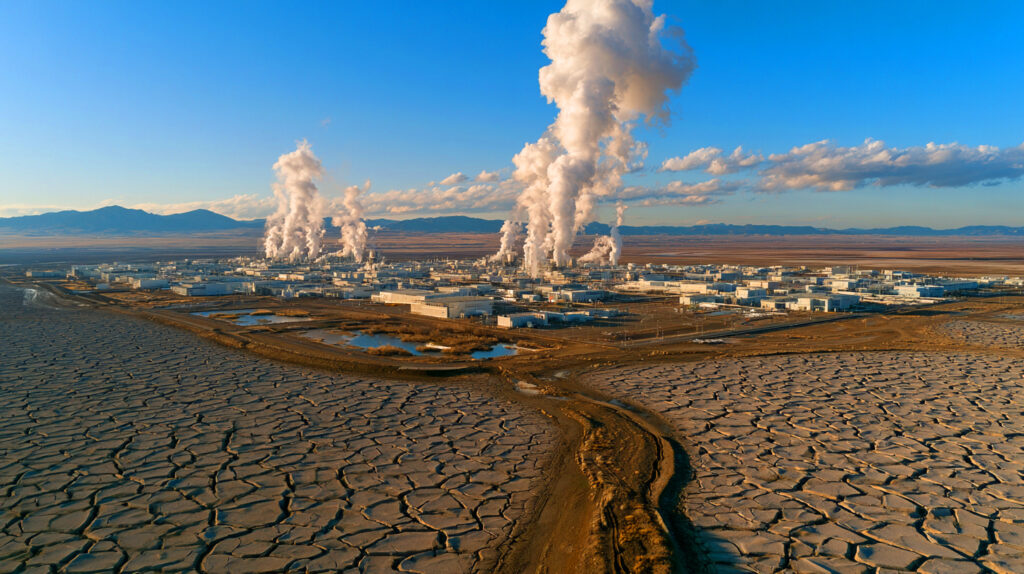
Water does not appear in any of the marketing materials for artificial intelligence. The glossy websites, the enthusiastic press releases, the TED talks about AI curing cancer and solving climate change, none of them mention water. None of them show you the cooling towers, the millions of gallons per day, the aquifer drawdown reports, the municipal water contracts negotiated quietly with local utilities while communities sleep.
This is not an accident. Water is the most politically explosive resource in American and global life. The AI industry understands this. That is why water almost never appears in the public conversation about AI.
This article is about the water. The actual water.
ONE CONVERSATION. ONE WATER BOTTLE.
A 2023 study from the University of California, Riverside estimated that a single conversation with ChatGPT uses approximately 500 milliliters of water. Half a liter. A standard bottle of water. Not metaphorically. Literally. The water is used in the data center cooling systems that prevent the chips generating your answer from overheating.
ChatGPT has over 800 million users. They conduct millions of exchanges daily. The water mathematics are not difficult to do. They are simply never presented to you when you open the app.
Microsoft published data showing that its global water consumption increased by 34% between 2021 and 2022, the period when its AI development was accelerating most rapidly. Google’s water use increased by 20% in the same period. These are billions of gallons of water, drawn from municipal supplies, industrial sources, and in some cases directly from freshwater aquifers, in communities that were not always consulted about whether they had water to spare.
THE CHILE CASE
In 2020, Google received permits to build a $200 million data center in Santiago, Chile. The permit covered the facility’s water needs: 7.6 billion liters annually, drawn from the potable water supply of the Santiago metropolitan area.
Seven point six billion liters. Every year. From drinking water.
Chile is in the grip of its worst drought in recorded history. The country’s water crisis has been building for decades, and has produced water rationing in rural communities, collapsed agricultural livelihoods, and a water rights system that has increasingly concentrated access to water among large industrial users at the expense of small farmers and rural communities.
An environmental activist organization called MOSACAT began protesting the project in 2019. They staged demonstrations that received minimal mainstream coverage. They persisted for four years. They provided technical expert testimony. They filed legal challenges.
In February 2024, Santiago’s Environmental Tribunal suspended the permit. In September 2024, Google announced it would halt the project entirely and start from scratch.
Four years of sustained advocacy. Two billion gallons of annual water extraction stopped. By a small group of activists with no institutional backing, no corporate funding, no political allies. Just documentation, persistence, and a courtroom where the evidence could not be ignored.
This is the most complete victory against a hyperscaler data center anywhere in the world. Most people have never heard of it.
THE AMERICAN WATER WARS
In Tucson, Arizona, the No Desert Data Center Coalition formed in response to a proposal to build a data center campus on 290 acres of living Sonoran Desert, a proposal that would require drawing water from aquifers already under stress. By the time your community finds out about a data center, organizer Lee Ziesche says, they have been working on it for years. Amazon ultimately withdrew from the project after pressure, but the developer has attempted to re-advance it, and the fight continues.
Ireland presents perhaps the most extreme national-scale example. By 2024, data centers consumed 22% of Ireland’s national electricity supply. The grid operator EirGrid imposed what amounts to a moratorium on new data center connections in the Dublin area, effective through at least 2028.
THE CHOICE NOBODY IS TALKING ABOUT
The water consumption of AI data centers is not an inevitable feature of the technology. It is a design choice.
Immersion cooling, which submerges computing hardware directly in a non-conductive liquid, eliminates water evaporation entirely. Air cooling with advanced heat exchange can dramatically reduce water use. Microsoft has built experimental data centers that use zero fresh water for cooling. The technology exists. The engineering is mature.
The reason these alternatives are not universally deployed is cost. The upfront capital cost is higher than building a conventional water-cooled facility, even accounting for the ongoing water expenses.
In other words: the AI industry is choosing cheaper construction over community water security. It is externalizing the cost of its water consumption onto communities because those communities have limited legal mechanisms to force the industry to internalize that cost.
This is not a technology problem. It is a governance problem. And the communities that have successfully pushed back have, in almost every case, done so by forcing the industry to internalize costs it was attempting to externalize.
THE WATER WE OWE THE FUTURE
An aquifer is not a tank. It accumulates over geological timescales. The Ogallala Aquifer, which underlies portions of eight Great Plains states, accumulated its water over millions of years. It is currently being depleted at a rate that exceeds natural recharge by a factor of several hundred. At current depletion rates, significant portions of it will be economically unproductive within decades.
No amount of AI capability will refill it.
The data center that draws from an aquifer today is borrowing water from children who are not yet born. That is not a metaphor. That is a physical description of what aquifer depletion means.
Every community that has fought a data center water permit and won has protected something that cannot be manufactured, cannot be replaced, and cannot be bought back at any price once it is gone.
Sources: University of California Riverside 2023 study · Microsoft sustainability reports · Google environmental reports · Santiago Environmental Tribunal ruling February 2024 · EirGrid capacity statements · Data Center Watch
Cricketpocalypse is an independent channel. No corporate funding. No AI company money. Just the facts and the bugs.