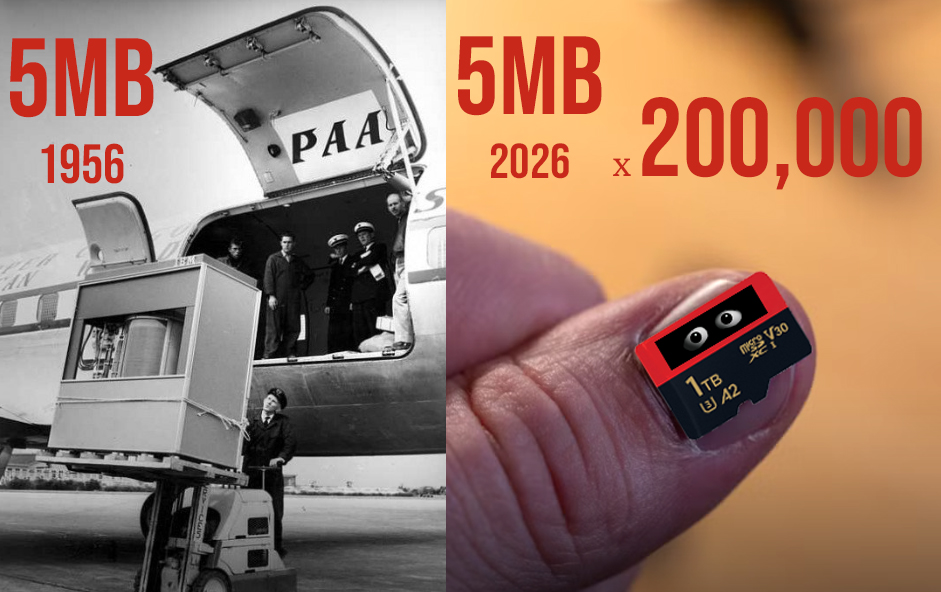
There is a photograph that changed the world. Taken sometime in the late 1950s, it shows a machine, enormous, industrial, the color of government buildings, standing in a room it almost entirely fills. The machine stores five megabytes of data. Five. The equivalent of a single low-resolution photograph. It weighs over a ton. It requires a team of engineers to maintain.
Now reach into your pocket or your bag or your desk drawer and find a micro SD card. The kind you buy at a gas station for nine dollars. That card stores 128 gigabytes. That is 131,072 megabytes. That is 26,214 times more data than the 1956 machine, stored in something smaller than your thumbnail.
The size difference is not incremental. It is civilizational. It happened within a single human lifetime.
This article is about what happens when you apply that same compression ratio, twenty-five thousand to one, to what the AI industry is building right now, in your state, on your water, with your electricity, through your community’s soil.
THE NUMBER YOU NEED TO KNOW
Forty thousand acres. That is the land footprint being planned for AI data center infrastructure in some of the largest projects currently under construction or proposed in the United States.
To give you a frame of reference: the entire city of Washington DC, the capital of the United States, home to the White House, the Capitol Building, the Lincoln Memorial, and four hundred thousand people, covers approximately 39,000 acres.
We are talking about building something larger than Washington DC. For servers.
THE MATH
Let us do the calculation the AI industry hopes you never do.
Forty thousand acres divided by 25,000 equals 1.6 acres. After one compression generation, roughly ten to twenty years by historical trajectory, the same computing capacity that currently requires a land mass larger than Washington DC requires approximately one and a half acres. A city block with parking.
Divide 1.6 acres by 25,000 again. The answer is 0.000064 acres. Approximately 2.8 square feet. The size of a coffee table. A medium one. Nothing fancy.
This is not science fiction. This is the documented historical trajectory of computing technology applied to its current physical form. The industry knows this. The engineers know this. The executives spending $690 billion in 2026 alone on physical infrastructure know this.
WHAT IT COSTS THE PEOPLE WHO DID NOT DECIDE
The compression calculation tells you what will happen to the technology. It does not tell you what will happen to the land. To the water. To the air. To the electricity bills. To the communities.
Those things do not compress. They do not miniaturize.
An aquifer drained in five years takes ten thousand years to refill. A desert ecosystem paved does not return in any human lifetime. A rural community’s character, its quiet, its darkness, its identity as a place, once industrialized, is changed for generations.
In Tucson, Arizona, a company called Beale Infrastructure, a subsidiary of Blue Owl Capital, reportedly building for Amazon, has proposed a data center campus on 290 acres of living Sonoran Desert. The saguaro cactus, the iconic symbol of the American Southwest, takes seventy-five years to grow its first arm. Individual saguaros live two hundred years or more.
A data center would be built on it. Operated for twenty to thirty years. Then decommissioned when the miniaturization arrives. The saguaro that was there would have been seventy years from its first arm. It will not grow back on any timeline that matters to the humans living nearby.
THE COMPANIES BEHIND THE MASK
One of the most consistent patterns in data center community conflicts is that communities often do not know who they are fighting until the fight is almost over.
In Brandy Station, Virginia, the applicant for a $12 billion data center campus was listed as Culpeper Acquisitions LLC. Only through investigative journalism and public records requests did local advocates discover the likely end user was Google or Meta. In Tucson, Arizona, the applicant was Beale Infrastructure, a private equity subsidiary, with Amazon reportedly as the ultimate end user.
This opacity is deliberate. A permit application from Amazon Web Services for a 290-acre Sonoran Desert data center campus generates a different community response than one from Beale Infrastructure for a technology facility. The anonymity is almost always deliberate. The transparency almost always has to be forced.
THE COMMUNITIES THAT WON
In 2024, the residents of Chesterton, Indiana organized against a proposed $1.3 billion data center campus. They showed up at planning and zoning meetings. They made signs. They called their council members. They testified. The developer withdrew.
On the same day that victory was confirmed, organizer Wendy Reigel received a shipment of 200 No Data Center yard signs she had ordered for the fight. They arrived after the fight was over. She packed every one of them into boxes and shipped them to Peculiar, Missouri, where the next fight was just beginning. The Peculiar city council voted unanimously to reject the project in September 2024.
The total value of data center projects blocked, delayed, or cancelled in 2025 alone: $156 billion.
THE QUESTION THAT REMAINS
In fifty years, the generation of children who inherit the world we are building right now will walk past photographs of today’s AI data centers in whatever museums or digital archives they inhabit. They will see images of forty-thousand-acre campuses, cooling towers, power lines stretching to the horizon, desert land stripped and paved for a generation of computing. They will know that all of it was replaced by something the size of a fingernail.
They will ask: was the damage worth it?
The honest answer, the answer that the $690 billion annual investment is actively preventing anyone from having to say out loud, is that the damage was not inevitable. The communities that bore the cost did not agree to bear it. The water that was taken was not offered freely.
The damage was chosen. By specific people. For specific financial reasons. At the expense of specific communities that had less political power than the companies that made the choice.
That is not progress. That is extraction. And the first step to stopping it is knowing what you are looking at when you see a data center going up in your county.
You are looking at the 1956 refrigerator. It is being built on your water. And it will be obsolete before the saguaro grows its first arm.
Sources: Data Center Watch · Heatmap News · Washington Post · TechPolicy.Press · Visual Capitalist
Cricketpocalypse is an independent channel. No corporate funding. No AI company money. Just the facts and the bugs.