The resistance is winning bigger than anyone reported. Maine just banned them statewide. And the industry is so rattled it is turning to nuclear power to escape your city council.
Let’s start with the number.
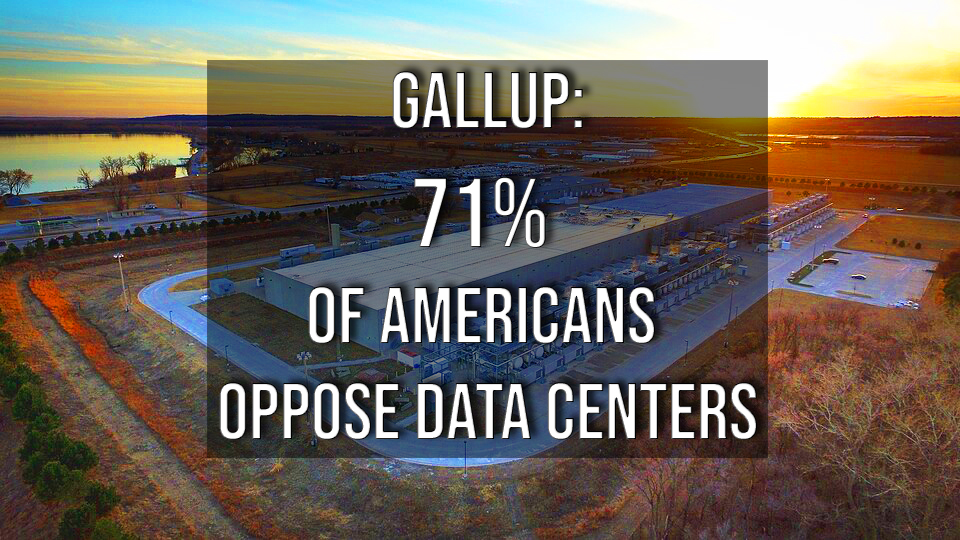
71%.
That is the percentage of Americans who told Gallup they oppose AI data center construction in their area. 48% said they strongly oppose it. Only 7% strongly support it.
This is not an activist poll. This is not a data center resistance organization asking its own members how they feel. This is Gallup, the most credible polling organization in America, asking a representative sample of the American public a straightforward question. And nearly three out of four Americans said no.
That number needs to sit for a moment before we move on.
The AI industry has spent billions of dollars on lobbying, public relations, and political access. It has placed allies in the White House, the Senate, and the regulatory agencies. It has framed its expansion as a matter of national security, economic competitiveness, and American technological supremacy. It has invoked China in every hearing, every press release, and every phone call to every elected official who showed signs of asking questions.
And after all of that, 71% of Americans told Gallup they do not want a data center in their community.
THE RESISTANCE IS WINNING. HERE IS THE PROOF.
Community opposition in the United States alone has blocked or delayed at least $64 billion in data center construction projects since 2024. Globally the number is far larger — $156 billion in projects were stopped or delayed in 2025 alone when all forms of opposition are counted. That number is expected to increase as more projects come before local zoning boards and planning commissions whose members answer to voters rather than to investors.
In Warrenton, Virginia, residents voted out every town council member who supported construction of a local Amazon data center. The new council voted unanimously to approve a zoning change that permanently banned all data centers in the entire town. Not delayed. Not restricted. Banned.
Similar stories have played out in Oregon, Utah, New Jersey, and Massachusetts.
And then came Maine.
This month, Maine became the first state in America to pass a statewide ban on AI data center construction. Not a moratorium. Not a pause pending review. A ban. A state legislature looked at what was happening in communities across the country and decided that the default answer to AI data center proposals in Maine is no.
That is a precedent. When one state legislature passes a statewide ban, the legislators in every other state capitol take notice. They start asking their staff to research what their state’s current rules are. They start getting calls from constituents who read about Maine and want to know why their state has not done the same thing.
The industry understands this dynamic. That is why what happened next is so revealing.
THE NUCLEAR PIVOT
When an industry starts fundamentally rethinking its basic infrastructure model, that is not a sign of confidence. That is a sign of pressure.
A nuclear energy startup called Oklo has proposed combining small modular nuclear reactors directly with AI data centers, creating co-located facilities that generate their own power and can be sited far from existing electrical grids. Far from existing grids means far from municipalities. Far from municipalities means far from zoning boards. Far from zoning boards means far from the 71% of Americans who just told Gallup what they think.
Read that sequence again slowly. The industry’s proposed solution to community opposition is to build its infrastructure somewhere communities cannot reach it.
That is not a technical solution. That is a political one. The industry is not trying to address the concerns that 71% of Americans have about water use, electricity consumption, environmental impact, and utility bills. It is trying to build somewhere those Americans cannot vote.
There are several problems with this plan beyond its fundamental contempt for democratic governance.
Oklo has not built a working reactor. Their first prototype is scheduled to go online late next year and has not been tested at scale. The technology is described even by investors friendly to the company as highly speculative. The timeline from prototype to nationally scaled co-located data center infrastructure is measured in decades, not years.
The communities that are fighting data centers right now do not have decades to wait for the industry to find a workaround. They have zoning board meetings next month.
WHAT THE GALLUP NUMBER ACTUALLY MEANS
71% opposition is not a niche concern. It is not a left-wing concern or a right-wing concern. The Gallup poll found that opposition to AI data center construction was one of the least politically divisive issues in American public life. Republicans oppose them. Democrats oppose them. Rural communities oppose them. Suburban communities oppose them.
The industry’s lobbying apparatus is built for a world where public opinion is divided and persuadable. It is not built for a world where 71% of the public has already made up its mind.
Every elected official in America who represents a community where a data center is proposed now has a Gallup poll telling them that opposing the project is the politically safe position. Approving it is the politically risky one. The electoral math has shifted. The industry’s money is still there. But the votes are moving in the other direction.
THE MAINE PRECEDENT AND WHAT COMES NEXT
Maine’s statewide ban will be challenged in court. The data center industry has the resources to litigate it extensively and the legal arguments are not settled. But the political signal is more important than the legal outcome in the short term.
Maine said no at the state level. The question now is which state says no next.
The communities in Indiana and Virginia and Michigan and Arizona and Tennessee who have been fighting these projects one zoning board at a time now have a model for what state-level action looks like. The organizers who have been building the resistance network for the past three years now have a template to take to their state legislators.
The industry spent billions on lobbying to prevent exactly this moment. The moment when the resistance stops being a collection of local fights and starts being a national political movement with polling numbers, electoral consequences, and state-level legislative victories.
That moment is here.
71%. First state ban. $64 billion blocked.
The cricket is louder than the machine. Gallup just confirmed it.
Sources: Gallup poll 2026 · The Motley Fool May 2026 · Data Center Watch · Community opposition documentation 2024 through 2026
Cricketpocalypse is an independent channel. No corporate funding. No AI company money. Just the facts and the bugs.